
ENTERPRISE SEARCH
College Board - Turning complex student data into confident recruitment decisions.
Role: Senior Product Designer; end-to-end product ownership
Duration: More than one year
Product: B2B enterprise SaaS
Users: College and university enrollment teams
Team: Product, Engineering, QA, UX Research, Content Strategy, Accessibility and stakeholders
Tools: Figma, FigJam, Jira, Confluence and analytics/research tools: tree testing, surveys, 1:1 interviews weekly.
Responsibilities: Strategy, research synthesis, information architecture, workflows, interaction design, prototyping, design systems, usability testing support and implementation QA
I led the redesign of College Board’s Student Search experience, an enterprise platform used by enrollment teams to define student audiences using academic, geographic, demographic, behavioral, and interest-based criteria. I transformed a difficult filtering workflow into a connected decision-support system that helped users understand how each decision affected their audience before saving a search or placing an order.
Business problem
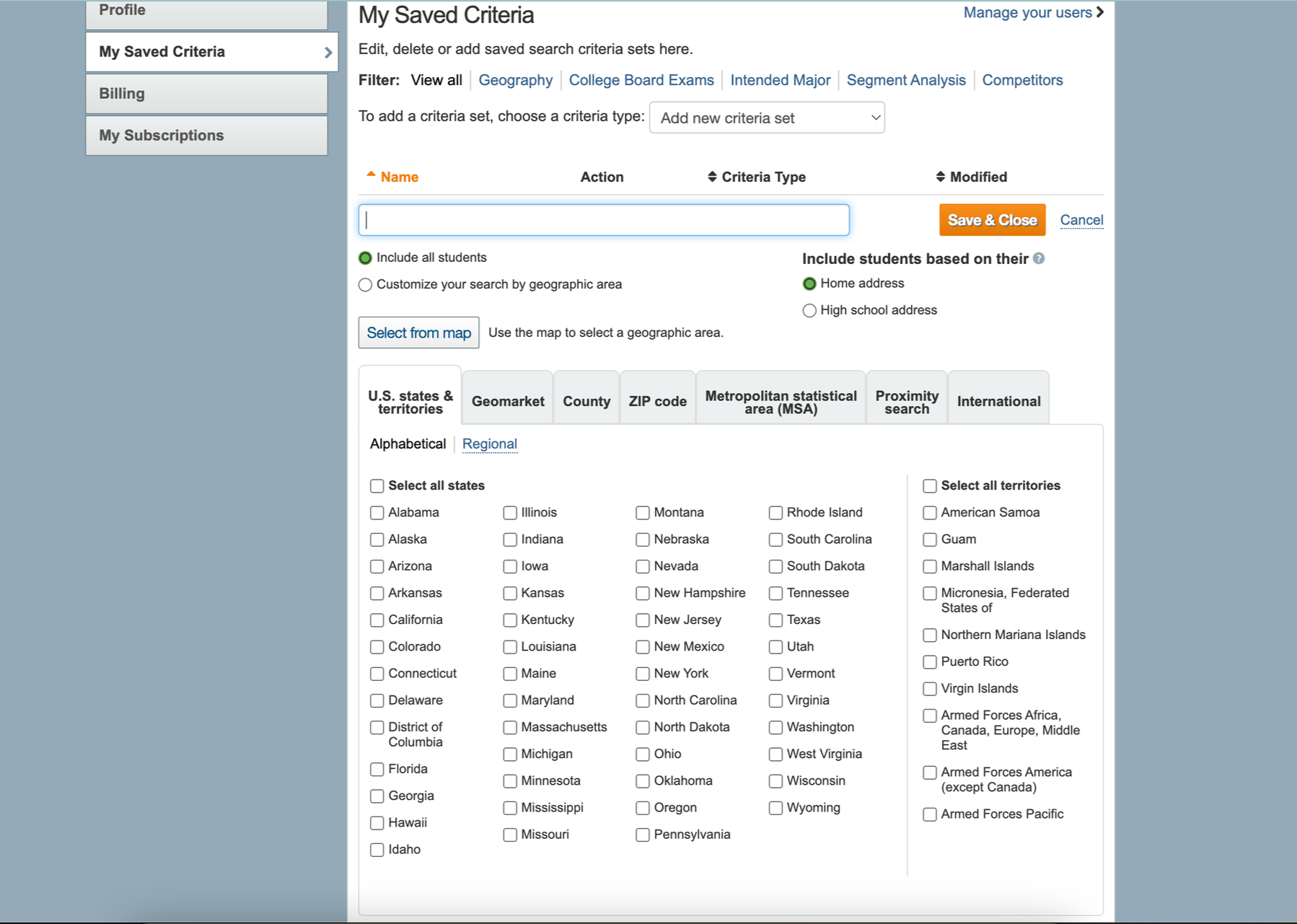
Student Search did not end when a user created a search or submitted an order. Enrollment teams returned to monitor activity, review orders, download files, duplicate previous work, and manage recruitment campaigns across multiple cycles. These workflows had evolved into disconnected pages with inconsistent navigation and duplicated information.
The interface reflected internal system boundaries rather than the way customers managed their work. Users had to remember where records lived, navigate into detail pages for common actions, and scan dense layouts that became harder to use as institutions accumulated hundreds or thousands of records.
I reframed the assignment from a set of screen redesigns into an information-architecture problem. The solution unified searches, orders, files, and fulfillment into a centralized workspace with advanced filtering, clearer hierarchy, progressive disclosure, and inline actions.
Legacy system constraints that limited how much of the data model could change
Stakeholder groups with competing definitions of "done" (enrollment ops vs. engineering vs. leadership)
Balancing familiarity for existing power users against a genuinely new mental model
Technical feasibility limits on what could be surfaced inline vs. what required a page transition


BUSiNESS STRATEGY
The strategy was to create an operational foundation that could support growing institutional datasets and connect the entire search lifecycle. Instead of optimizing isolated pages, the redesign established a shared workspace and reusable management patterns that could scale with additional record types and future capabilities.
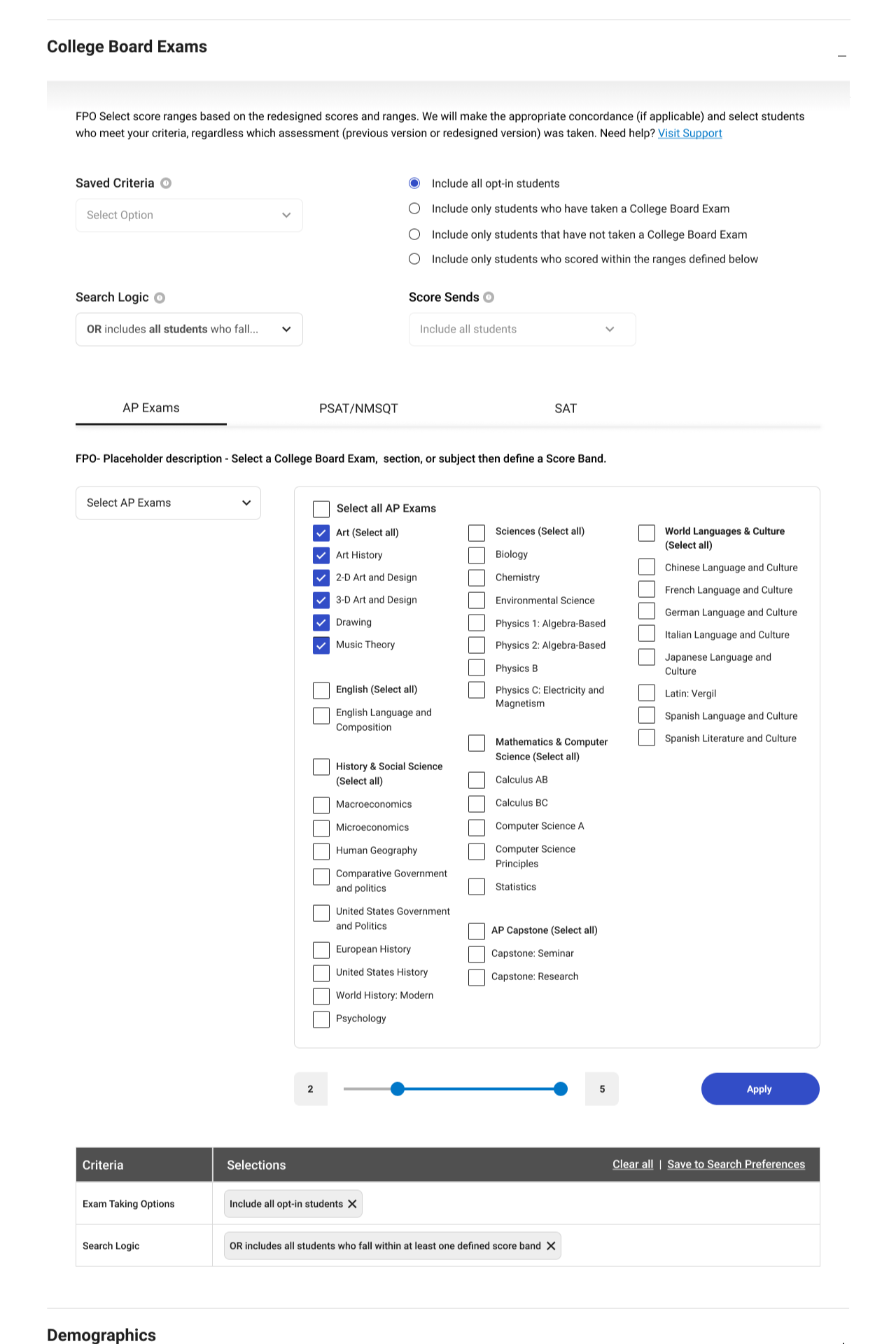
Define Audience > See Impact > Analyze Composition > Refine Strategy > Save or Order > Resume and Manage
Inventory the existing objects, statuses, actions, and duplicated information.
Organize the product around customer tasks rather than internal systems.
Bring high-frequency actions closer to the records they affect.
Support large historical datasets with search, filters, sorting, and clear metadata.
Reuse common table, status, filter, and action patterns across the ecosystem.

Main drivers of the experience
Find ability — users must quickly locate a specific record among years of activity.
Operational awareness — status, dates, relationships, and next actions should be easy to scan both visually and readability.
Efficiency — common actions should not require unnecessary detail-page navigation.
Scalability — the model must remain usable as the dataset and number of object types grow.
Consistency — searches, orders, files, and fulfillment should share predictable patterns.
User Confidence — destructive, irreversible, or high-impact actions require appropriate confirmation and feedback and live updates of action added items to ensure users plan each year accurately.
Key Metrics and KPI Definition
10% decreased time to locate a known search, order, or fulfillment file.
Task completion rate for high-frequency management tasks.
2 Number of page transitions required to complete an action.
36% Search and filter success rate.
48% decrease in inconsistent or failed file-download attempts.
26% decrease of support requests related to locating records, interpreting status, or accessing files.
DESIGN PROCESS
(DISCOVER, DESIGN, EVALUATE)
Discovery Workshops
I worked with Product and Engineering to inventory searches, orders, files, fulfillment records, statuses, and available actions. In a cross-functional workshop, we mapped where each object was created, how it changed over time, and which user tasks crossed internal system boundaries. This exposed duplicated information and clarified which relationships needed to remain visible in the new workspace.
White boarding and Brainstorming
I explored separate dashboards, a tabbed workspace, and unified record models. Concepts were compared against task frequency, dataset size, scanability, technical feasibility, and the need to preserve recognizable object types. The resulting direction used a centralized workspace with clear type and status cues rather than flattening every record into an indistinguishable list.
Usability Testing
Representative evaluation tasks were:
Find a search created during a prior recruitment cycle.
Determine whether the associated order was fulfilled.
Download the correct file.
Duplicate or reuse a prior search.
Filter a large record set by date, status, and order type.
Explain the relationship between a search, order, and fulfillment record.
applied learnings + FINAL SOLUTION
I strengthened metadata hierarchy, made filters reflect users’ retrieval strategies, surfaced common actions inline, and used progressive disclosure for secondary details. Interaction patterns were documented for empty states, large result sets, row actions, loading, permissions, and status variations. The redesigned workspace gave enrollment teams one place to search, filter, review, and act on recruitment activity from creation through fulfillment. It reduced context switching and created continuity between Enterprise Search, Bulk Ordering, and long-term record management.