
SAT Suite Score Reporting
College Board - Transforming score reports into guided student action
I redesigned responsive SAT Suite score reporting to help students understand complex performance data, identify improvement opportunities, and move directly into personalized practice and future-planning actions. The system also needed to support numerous score, eligibility, accommodation, and testing states within a consistent design system.
The Challenge
Receiving a score was only the beginning of the student journey. Students needed to understand what the result meant, which skills to improve, how they compared with relevant benchmarks, whether special eligibility conditions applied, and what they should do next. The existing report contained much of this information, but it lacked a clear progression and often required students to interpret dense data independently.
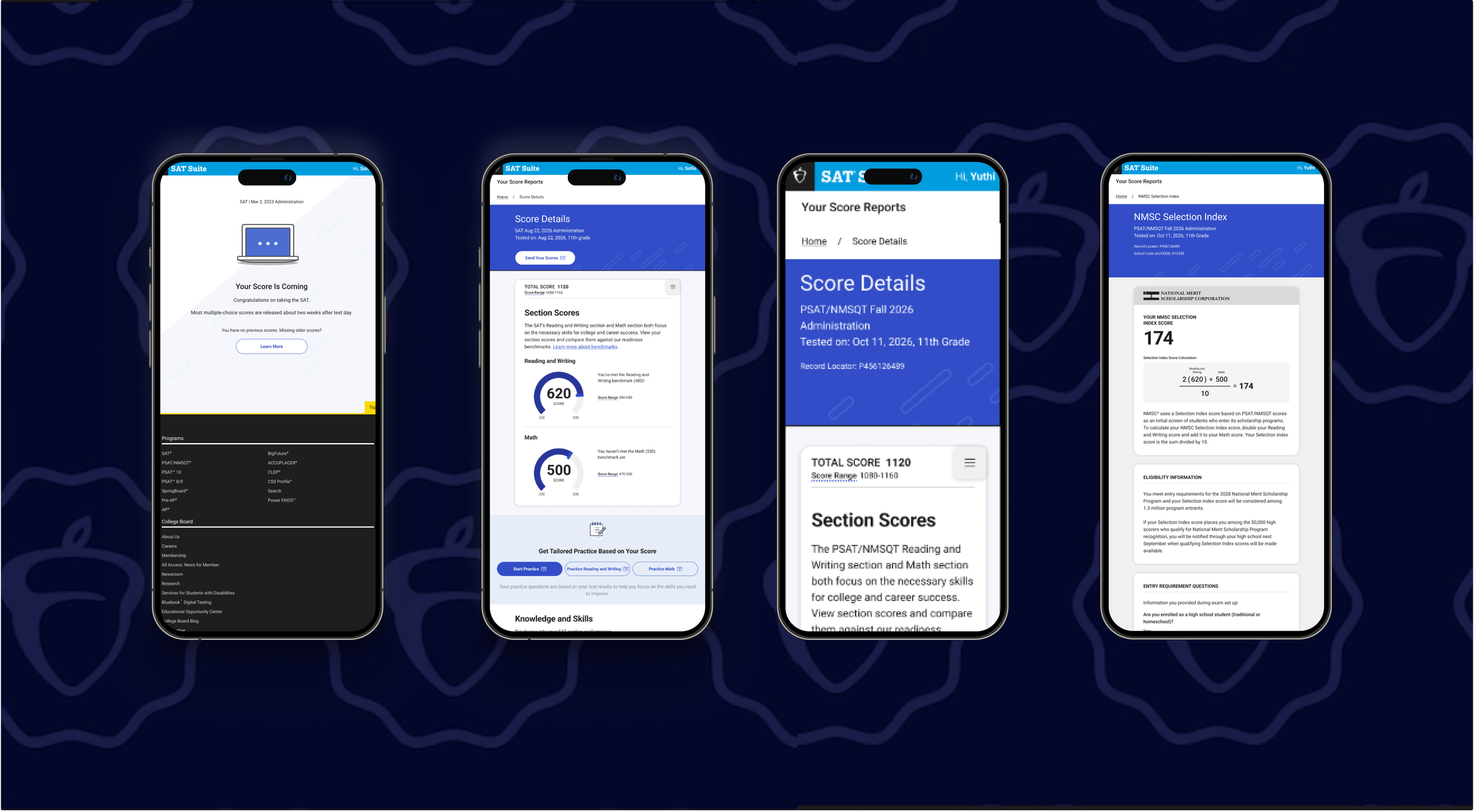
The challenge was to transform a static report into a guided decision experience while supporting dozens of score states and eligibility scenarios. The redesign established a clearer mobile hierarchy, connected performance data to targeted practice, added meaningful context and comparison, surfaced personalized next steps, and created scalable patterns for edge cases.
Role: Product Designer
Duration: 3 months
Team: Product Managers, Engineering, Content Strategy, Accessibility, Research, Analytics, and QA
Tools: Figma, FigJam, Jira, Confluence, analytics/research surveys, tree testing, interviews.
Platform: Responsive web / mobile web; clarify relationship to native BigFuture School app
Audience: High-school students receiving PSAT/NMSQT, PSAT 10, and SAT School Day results
Responsibilities: End-to-end UX/UI, information architecture, responsive interaction design, data visualization, component and edge-case design, specifications, design QA, and engineering collaboration.
BUSINESS STRATEGY PLAN
The strategy was to extend the value of the assessment beyond score delivery. By connecting results to practice, career exploration, college planning, AP recommendations, and score-sending actions, the experience could turn a high-attention score-release moment into continued engagement with the broader BigFuture ecosystem.
Make results understandable at a glance on mobile.
Connect performance to immediate, personalized action.
Provide context without encouraging misleading comparisons.
Support all required score and eligibility states through reusable patterns.
Maintain accessibility and consistency across the SAT Suite design system.
main drivers of the experience
Clarity — prioritize the information students need at each point in the report.
Actionability — connect scores and skill domains directly to useful next steps.
Context — explain comparisons and performance bands without overwhelming users.
Accessibility — ensure charts, hierarchy, labels, and interactions work for a broad student audience.
Scalability — accommodate National Merit, pending scores, accommodations, irregularities, and no-score states.
Consistency — reuse and extend SAT Suite components across breakpoints and report states.
key metrics
23% of Score-report comprehension and task success.
13% decrease of time to identify the most important improvement area.
11% increase of click-through from scores to personalized practice.
22% increase of completion of recommended next-step actions.
10% decrease of navigation or report-section drop-off.
8% decrease of accessibility issues and implementation defects across score states.
Design Process:
Discover → Design →Evaluate
Discovery Workshops
I worked with Product, Content, Engineering, Accessibility, and Research to map the questions students asked after receiving scores and the content required to answer them. Workshops prioritized content, identified dependencies, and cataloged score, eligibility, and exception states so the experience could scale beyond the primary happy path.
White boarding and Brainstorming
I explored alternative report sequences, card and section hierarchies, visual treatments for performance bands, and placements for practice and future-planning actions. Mobile-first concepts were reviewed against comprehension, accessibility, content accuracy, and component reuse.
Usability Testing
Use the actual study type and participant count (5)
Representative tasks included:
Explain what the overall and section scores mean.
Identify the skill domain requiring the most improvement.
Compare performance with a school, district, state, or national benchmark.
Begin personalized practice for a relevant subject.
Identify National Merit eligibility or the appropriate next step.
Understand what to do when a score is pending or unavailable.
APPLYING THE LEARNINGS
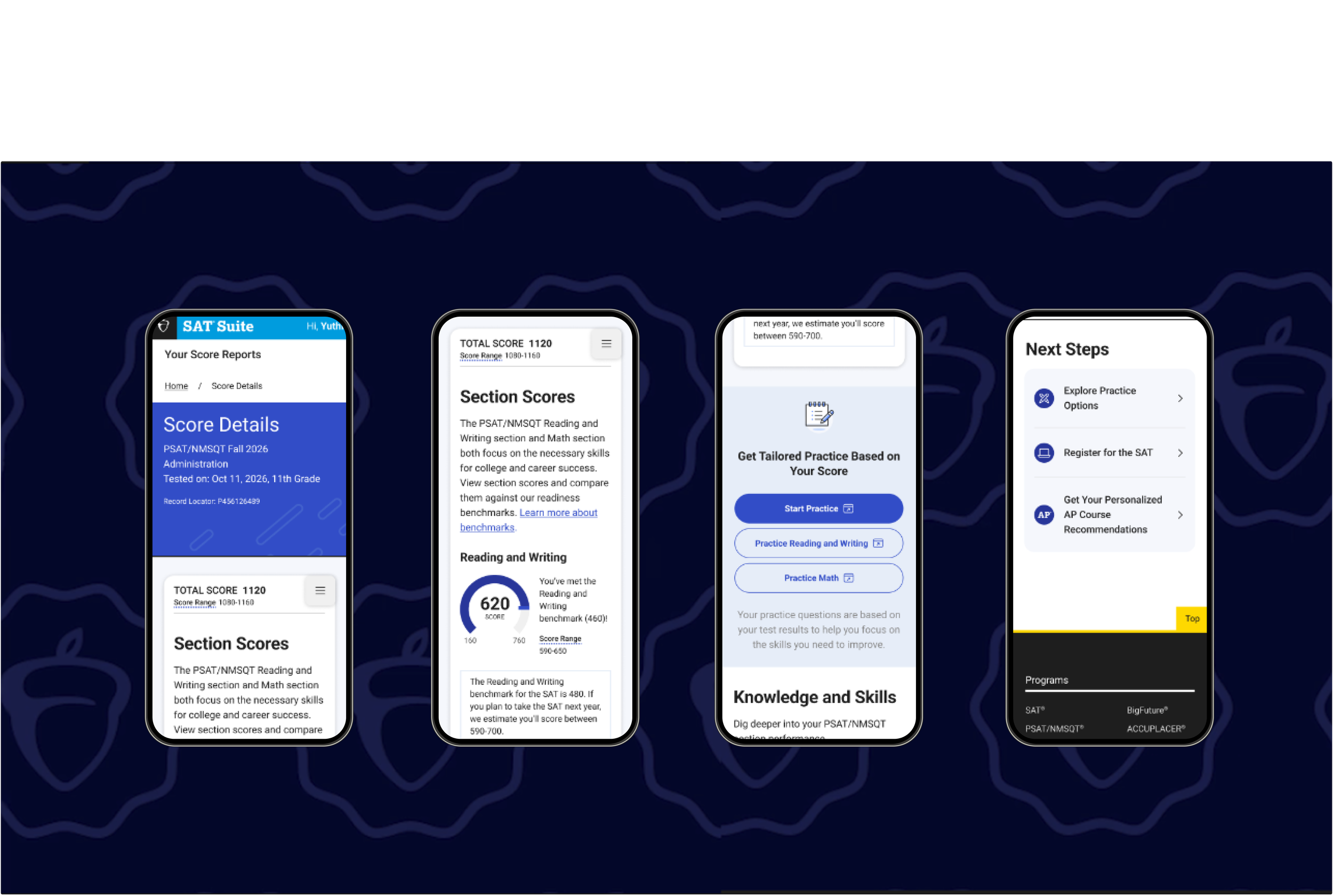
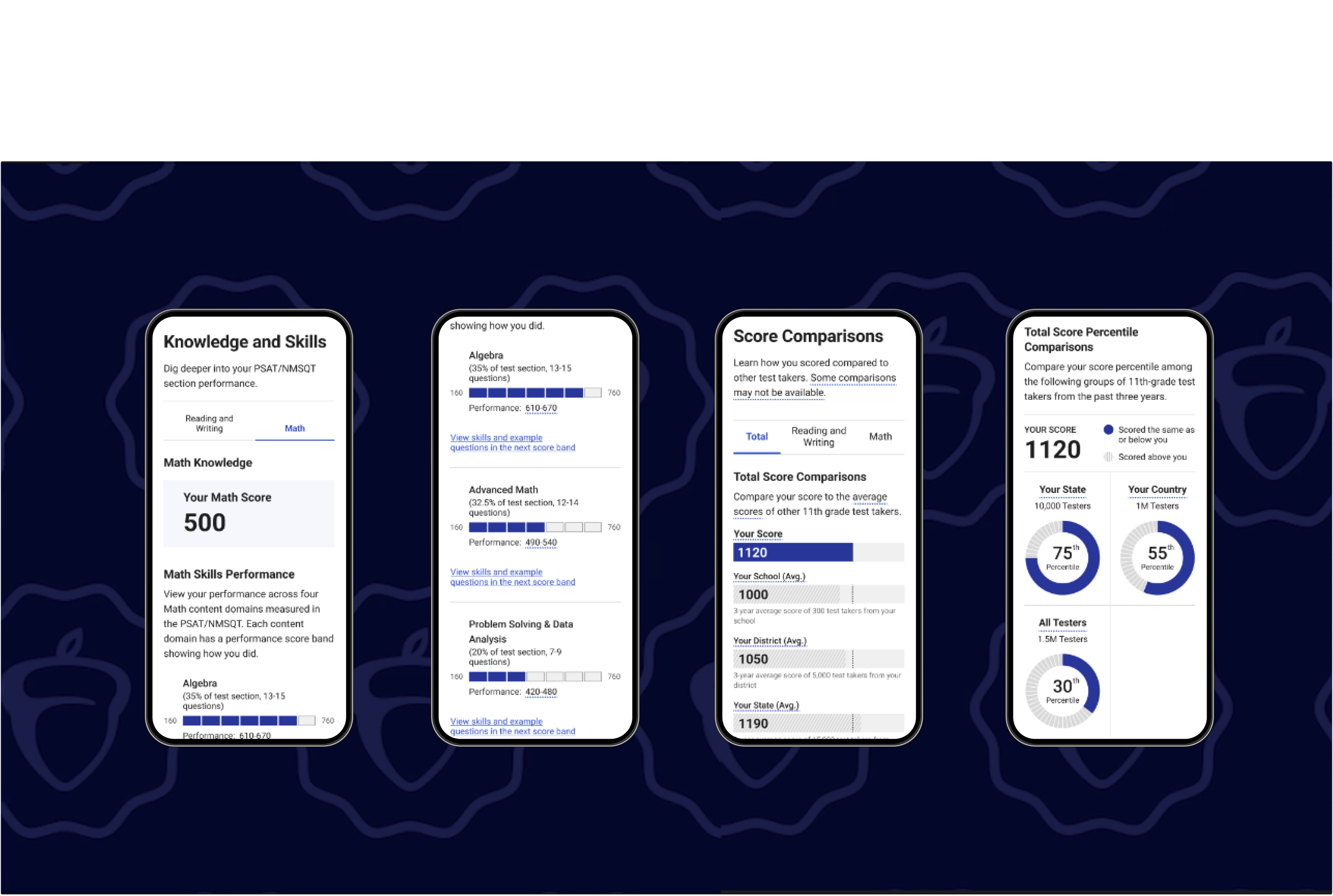
I strengthened the progression from score summary to performance detail to action. Personalized practice was placed immediately after results, Knowledge and Skills content was divided into measurable domains, comparison views were clarified, and future-planning recommendations were made more contextual. Edge-case layouts reused common structures while changing only the content and actions required by each state.
FINAL SOLUTION
The final responsive report helped students scan their scores, understand domain-level performance, interpret comparisons, and move into personalized practice or future-planning actions. The system supported National Merit eligibility, Alternative Entry, accommodations, missing Selection Index, irregularities, pending scores, unavailable scores, and multiple release states within a consistent experience.
challenges and tradeoffs
Balancing accurate assessment language with student-friendly clarity.
Presenting comparative data without adding unnecessary anxiety or confusion.
Prioritizing actions within a long, data-dense report.
Designing for many edge cases without creating disconnected templates.
Maintaining accessibility across charts, responsive layouts, and complex content.
Coordinating implementation and QA across numerous state combinations.