
Platform MANAGEMENT
BigFuture - Unifying searches, orders, and fulfillment into one operational workspace.
I led the redesign of BigFuture Profile Management, a B2B2C administrative platform colleges use to manage the information and media that appears to students on BigFuture. I transformed a fragmented form-based experience into a guided, role-aware profile-completion system with clearer progress, onboarding, media management, and implementation documentation.
Role: Senior Product Designer with end-to-end ownership
Duration: Eight months
Team: Product, Engineering, QA, Content, Accessibility, UX Research, and stakeholders [VERIFY exact count/titles].
Tools: Figma [add FigJam, Jira, Confluence, research tools only if used].
Platform: Responsive web; institutional admin SaaS / B2B2C
Responsibilities: UX strategy, workflow redesign, information architecture, research synthesis, role-aware logic, accessibility, specifications, prototyping, and implementation support.

Business problem
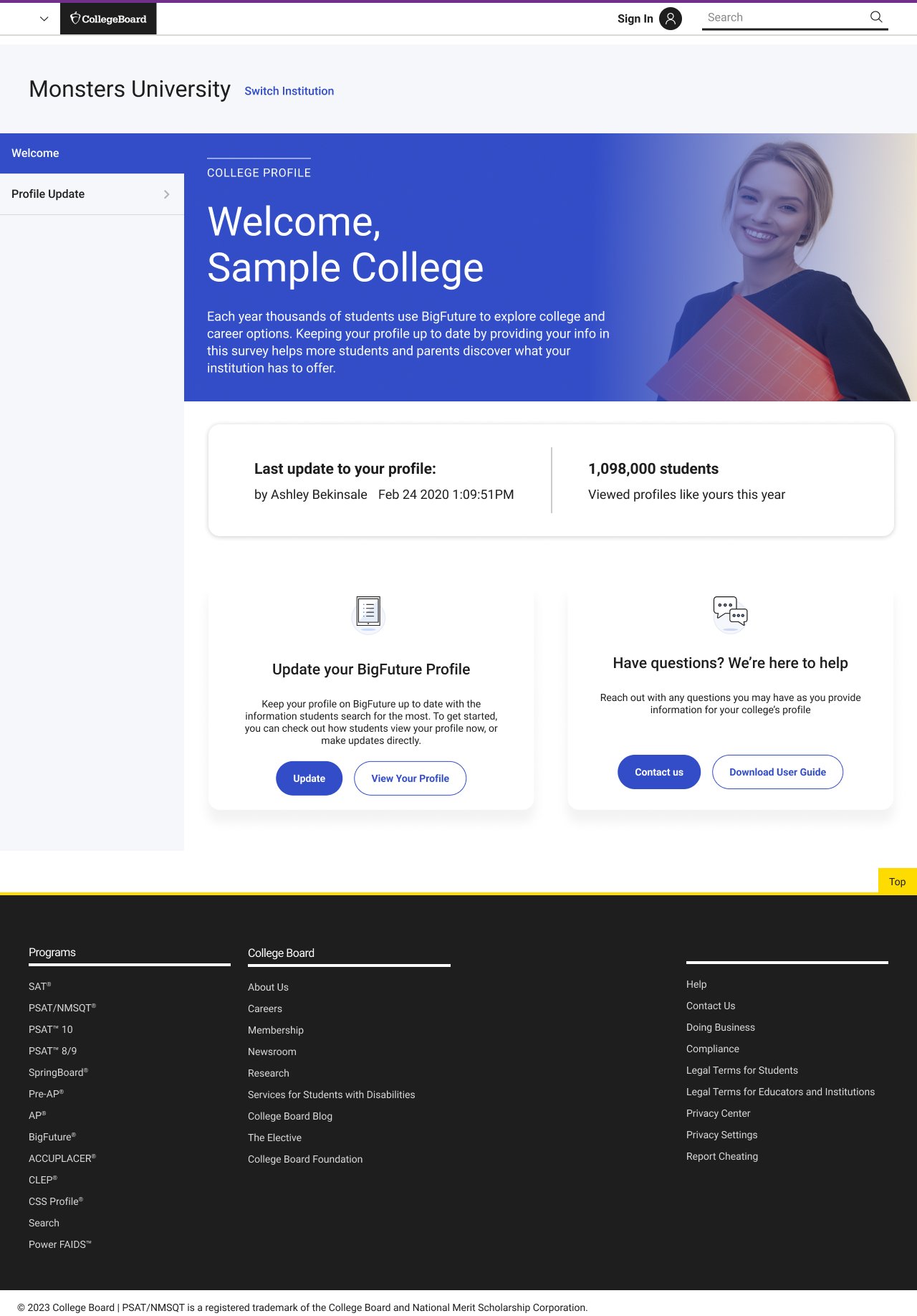
Institutions used BFPM to control how their profiles appeared to students on BigFuture. The legacy experience was functional but fragmented: users lacked a clear view of profile completion, information-entry tasks were weakly structured, media uploads created uncertainty, and different roles encountered different permissions and expectations.
This mattered beyond administrative efficiency. Incomplete or inconsistent data and media weakened an institution’s ability to represent itself accurately and reduced the quality and trustworthiness of the downstream student-discovery experience.
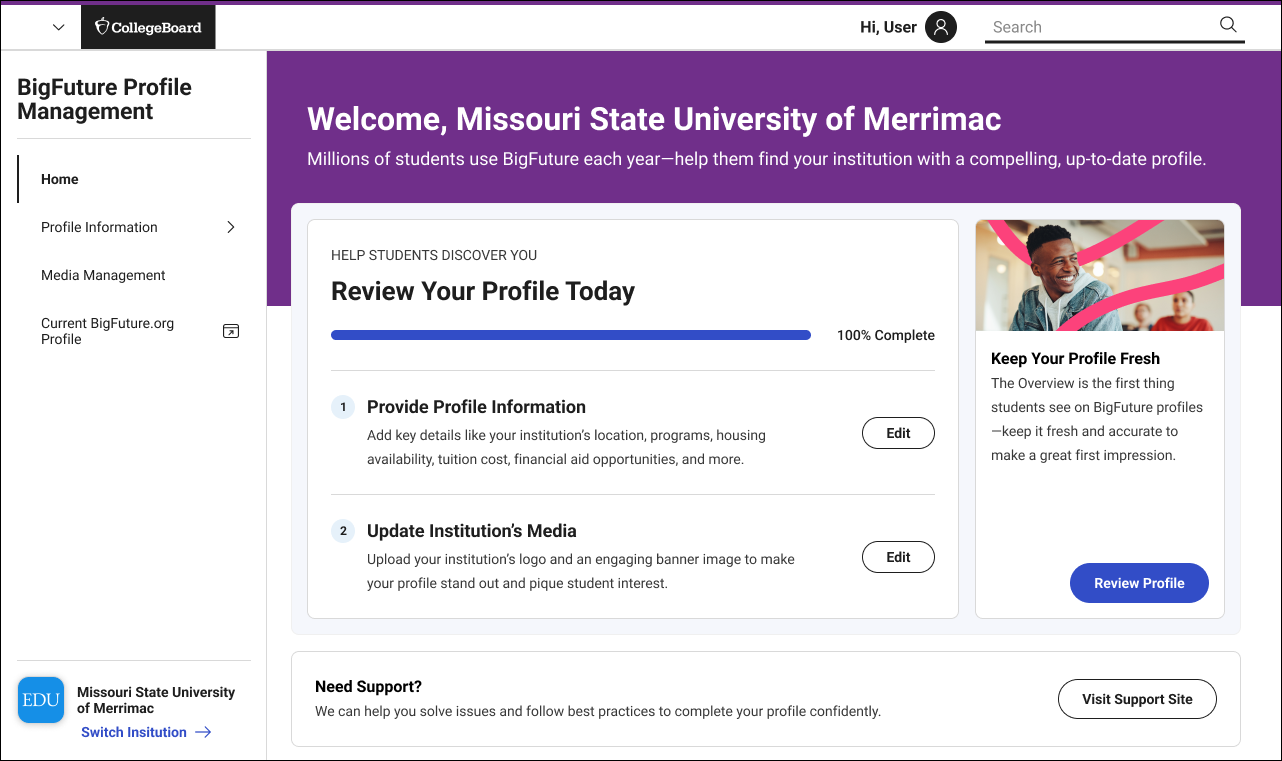
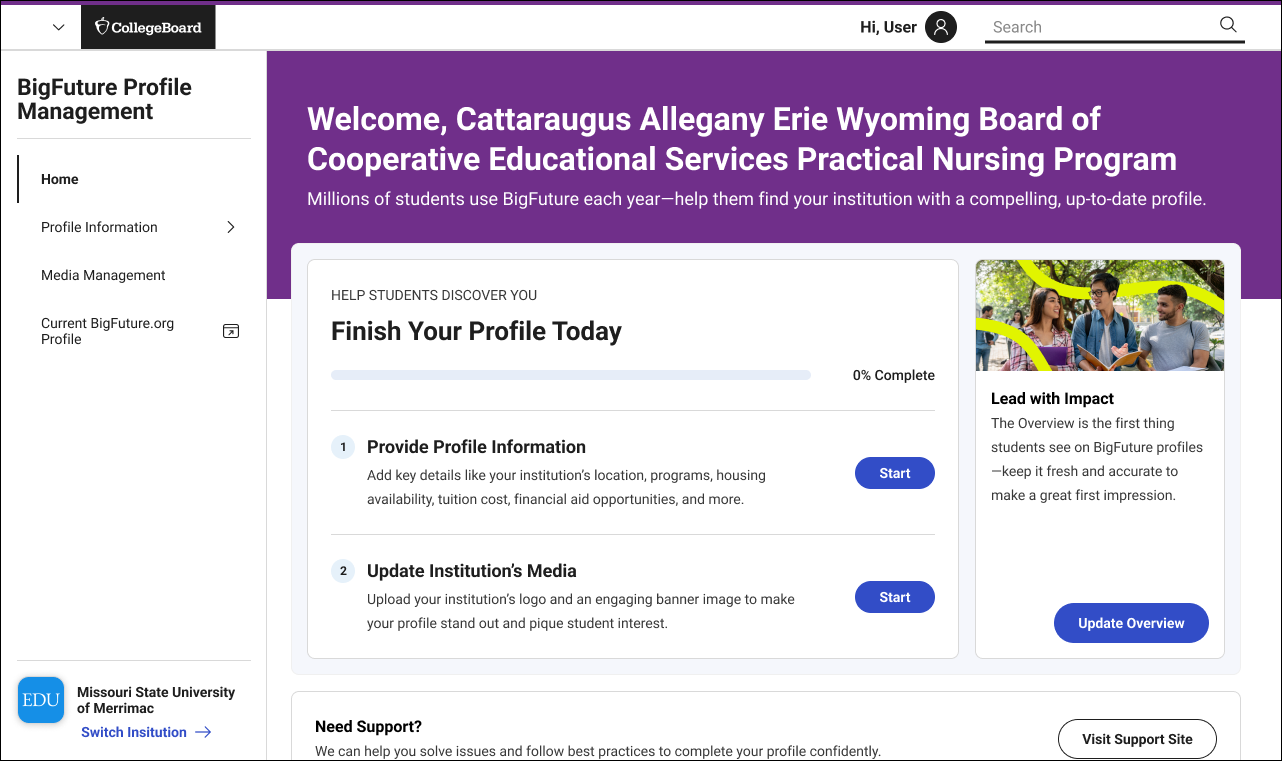
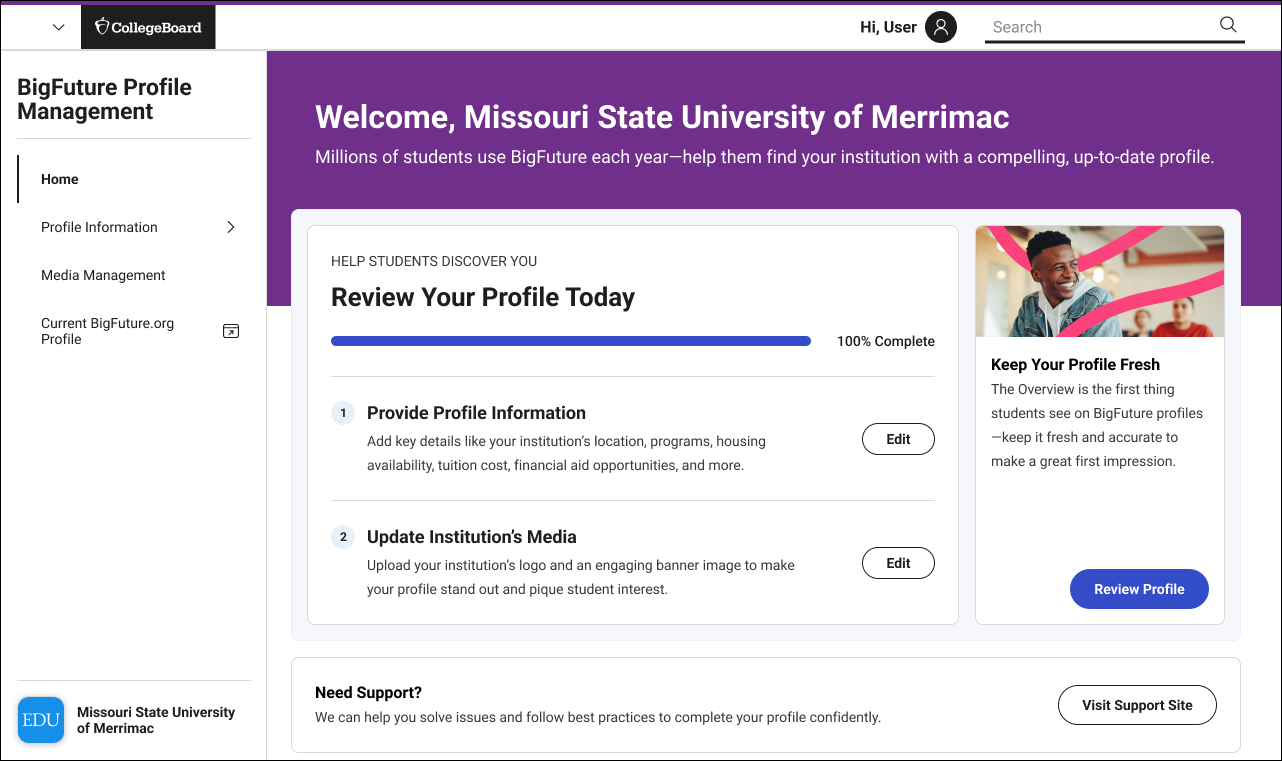
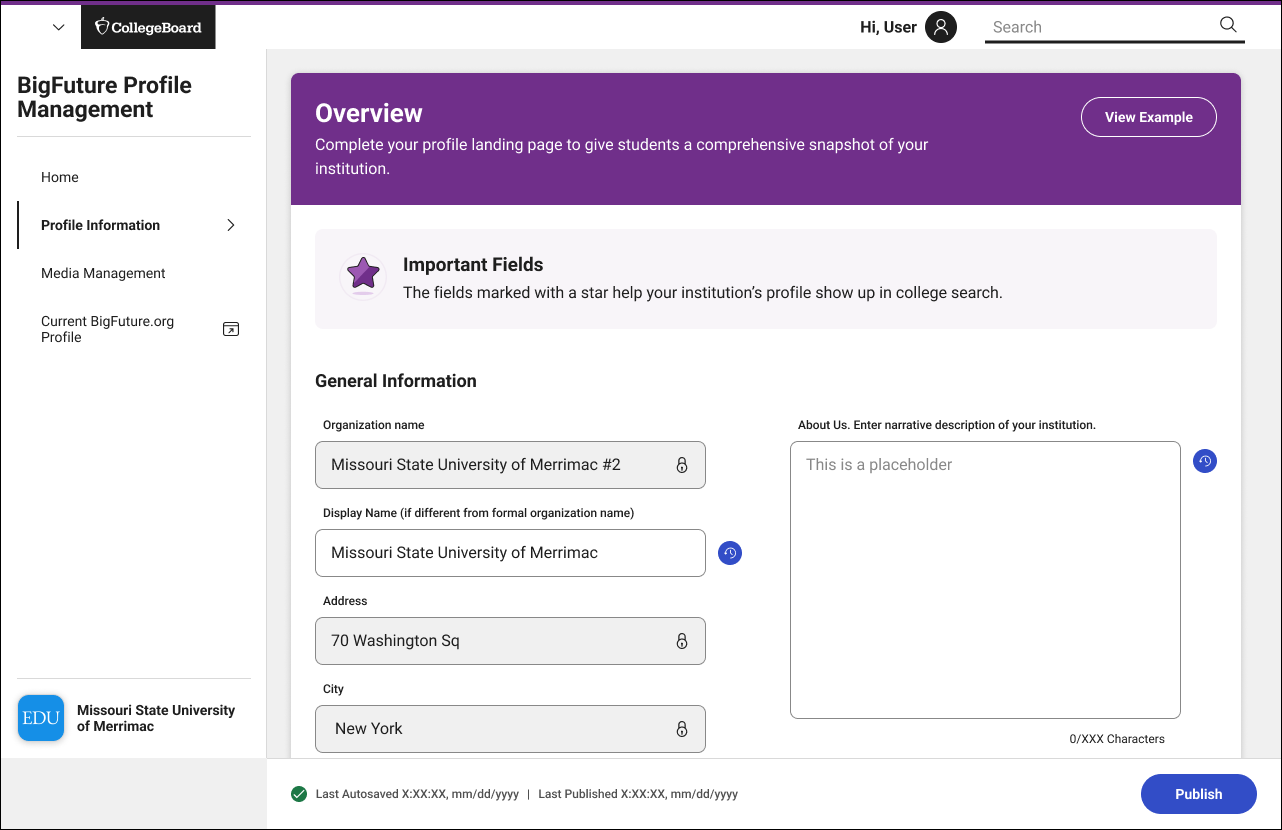
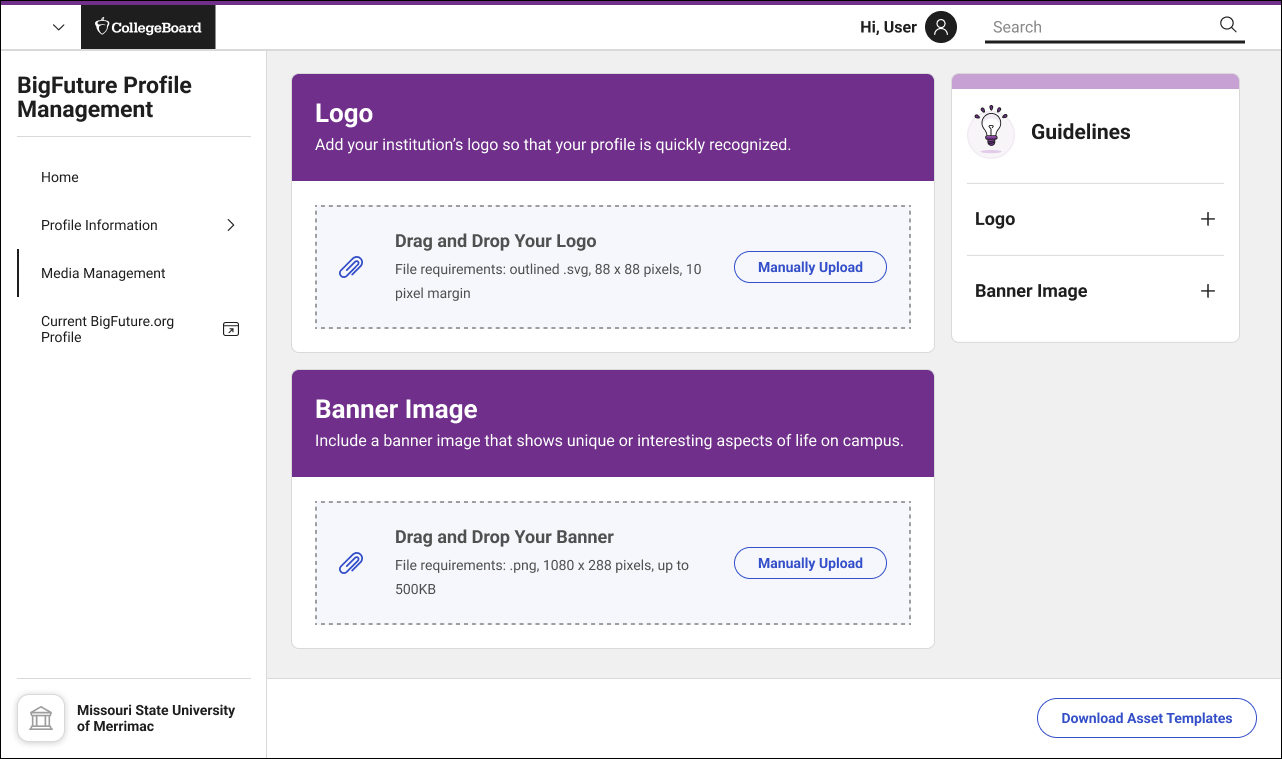
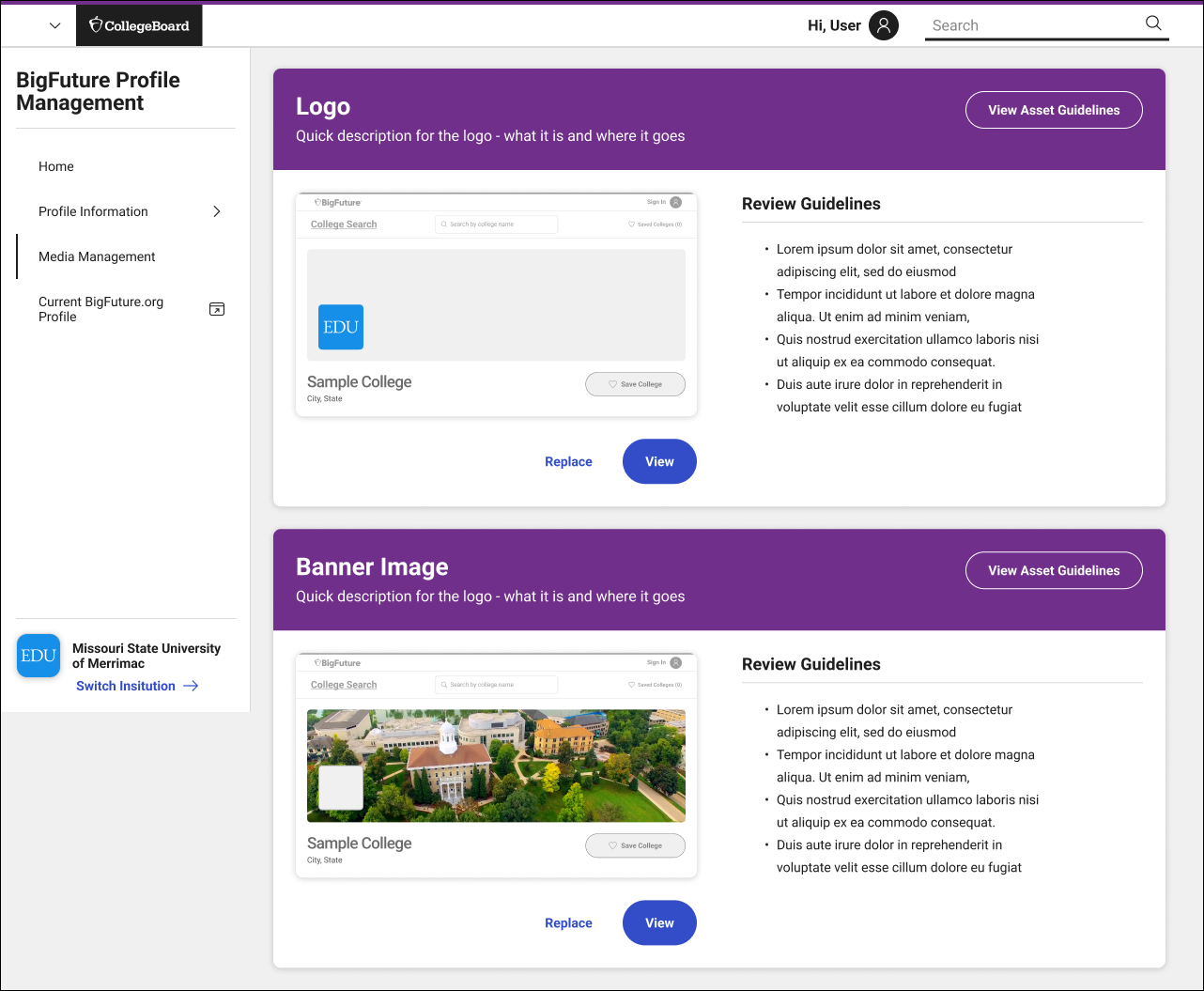
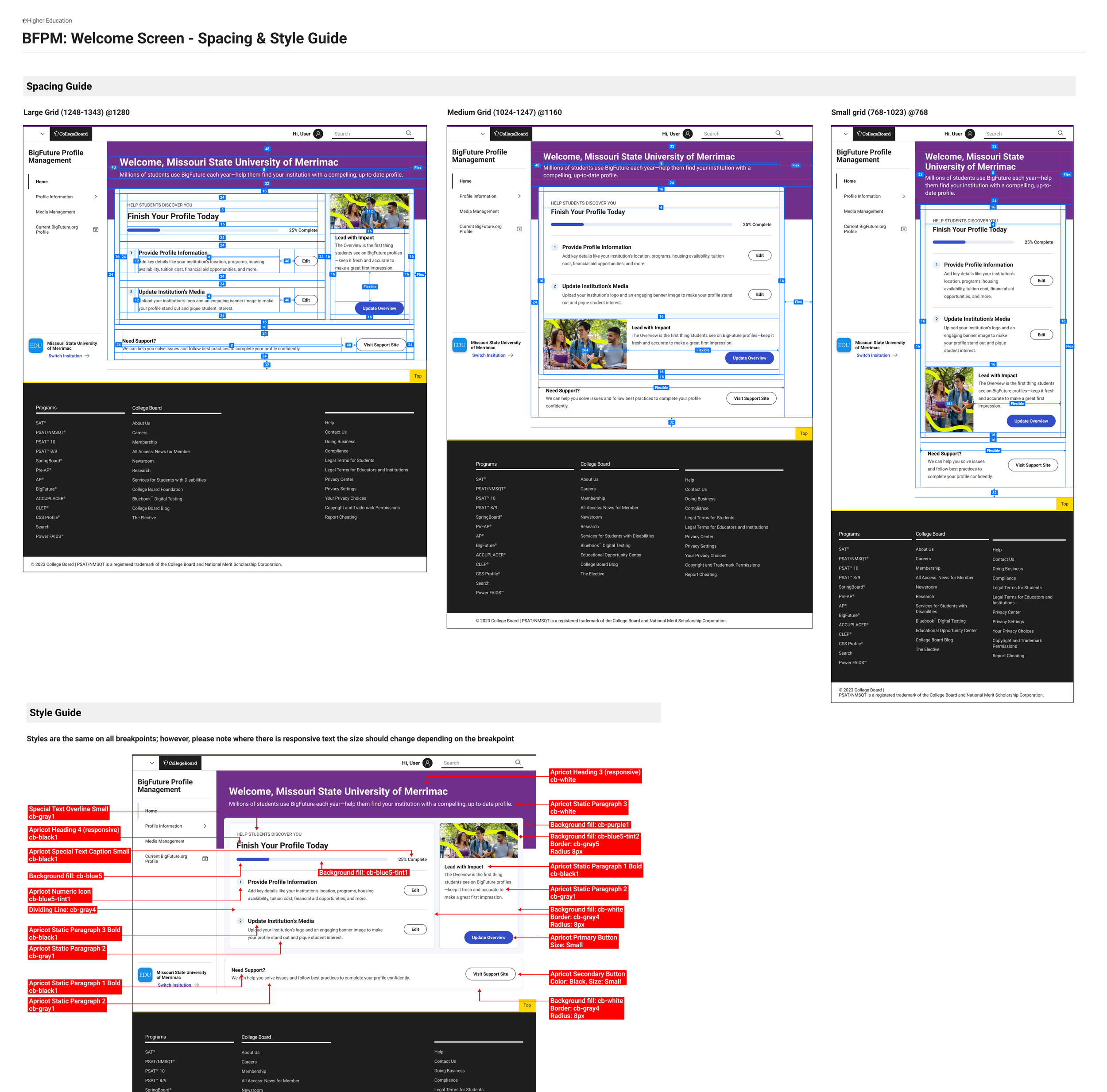
The business strategy connected institutional administration to student-facing profile quality. By helping institutions understand what to complete and how their work would appear, the product could improve data consistency, customer confidence, and the quality of information available to students.
Guide users toward the next meaningful profile task.
Make progress, requirements, permissions, and publication states visible.
Reduce incomplete or inconsistent institutional content.
Treat media upload as a trust and quality problem, not merely a file input.
Create patterns that could scale across roles, institution states, and future profile capabilities.
I redesigned BFPM as a guided system rather than a collection of forms. The new experience introduced an action-oriented homepage, visible completion status, structured onboarding, clearer profile-information hierarchy, improved media-upload guidance and preview, role-aware navigation, and implementation-ready specifications.
Business plan
Guidance — users should always understand what to do next.
Confidence — requirements, previews, approval, and publication states must be clear.
Role awareness — navigation and available actions must match permissions predictably.
Data quality — forms and media guidance should encourage complete, consistent profiles.
Accessibility — media and content guidance should support inclusive student experiences.
Implementation precision — complex states require detailed documentation for Engineering and QA.
main drivers of the experience
Profile completion rate and time to completion.
Percentage of profiles missing required information or media.
Upload failure, replacement, or abandonment rate.
Support requests related to image requirements, cropping, approval, or publication.
Task completion and confidence during onboarding and upload studies.
Implementation defects or clarification requests tied to state behavior.
The current page contains qualitative outcomes but no measured before-and-after performance. Keep qualitative statements tied to research or validation, and label business impact as expected unless post-launch data exists.
KEY METRICS & KPI DEFINITION
Discovery Workshops
I synthesized moderated sessions, survey data, a legacy-product audit, accessibility review, and cross-functional feedback. Working sessions with Product and Engineering mapped user roles, permissions, profile tasks, media states, approval behavior, and downstream student-facing consequences. The work reframed BFPM from “profile forms” into a role-aware content and brand-management system.
White boarding and Brainstorming
Affinity mapping revealed recurring breakdowns around progress, media requirements, cropping, preview, and approval. I explored different homepage models, completion indicators, task groupings, upload guidance, and role-based navigation patterns. Concepts were evaluated against clarity, scalability, accessibility, and implementation feasibility.
Usability Testing
Representative tasks included:
Determine what is required to complete an institution profile.
Identify the next incomplete task.
Upload a logo or banner using the stated requirements.
Predict how the image will appear after cropping and publication.
Determine whether an asset is awaiting approval or already published.
Explain which actions are available for the user’s role.
Research showed that users needed progress visibility; media upload created disproportionate anxiety; requirements appeared too far from the moment of action; preview and approval states were unclear; and accessibility guidance needed to be embedded rather than treated as supplemental.
Design Process:
Discover → Design → Evaluate
APPLYING THE LEARNINGS
I reframed the homepage around progress and next actions, reorganized profile information into a more digestible hierarchy, moved media requirements closer to the upload action, added clearer preview and feedback states, and defined role-aware navigation and permission behavior. I also created annotated specifications covering layout, spacing, components, navigation, fields, edge cases, and state variations.
final solution
The redesigned platform guided an institution from entry through profile information, media upload, review, and ongoing management. The experience made completion visible, reduced ambiguity during uploads, improved the relationship between administrative work and the student-facing profile, and gave Engineering and QA a clearer blueprint for implementation.
CHALLENGES & TRADEOFFS
Several user roles with different permissions and expectations.
Administrative decisions directly affecting a student-facing experience.
Structured data and brand/media management sharing one platform.
Accessibility requirements for forms, guidance, and uploaded media.
Balancing MVP delivery with scalable role, state, and component patterns.
Documenting behavior precisely enough to reduce implementation ambiguity.